

Methanol itself is not new. It is one of the world’s basic chemical building blocks, used in formaldehyde, acetic acid, plastics and fuels. What is new is the push to make it without coal or fossil natural gas. Global methanol production is estimated about 100 million tonnes per year, with almost all of it still fossil-based.
Green or low-carbon methanol is made through two main routes. The first is biomethanol, which uses biogenic feedstocks such as forestry and agricultural residues, biogas, sewage-derived gas, municipal solid waste, and black liquor from pulp mills. These feedstocks are converted into synthesis gas, or syngas, then cleaned, conditioned and passed through a conventional methanol synthesis loop. In other words, the carbon starts in biomass or waste, is converted into CO, CO2 and H2, and is then rebuilt into methanol. IRENA notes that the core process steps are feedstock pretreatment, gasification or reforming, gas cleaning, water-gas shift where needed, methanol synthesis and purification.
The second route is e-methanol. Here the feedstocks are renewable electricity, water and captured CO2. Electricity powers electrolysis to make hydrogen from water, and that hydrogen then reacts with CO2 in a methanol synthesis unit. The chemistry is established rather than experimental. What makes e-methanol challenging is not the reactor, but the upstream inputs: low-cost renewable power, electrolyser capacity, and a sustainable CO2 source. To produce one tonne of e-methanol, roughly 1.38 tonnes of CO2 and 0.19 tonnes of hydrogen are needed, and that about 10 to 11 MWh of electricity are required per tonne if CO2 is already available.
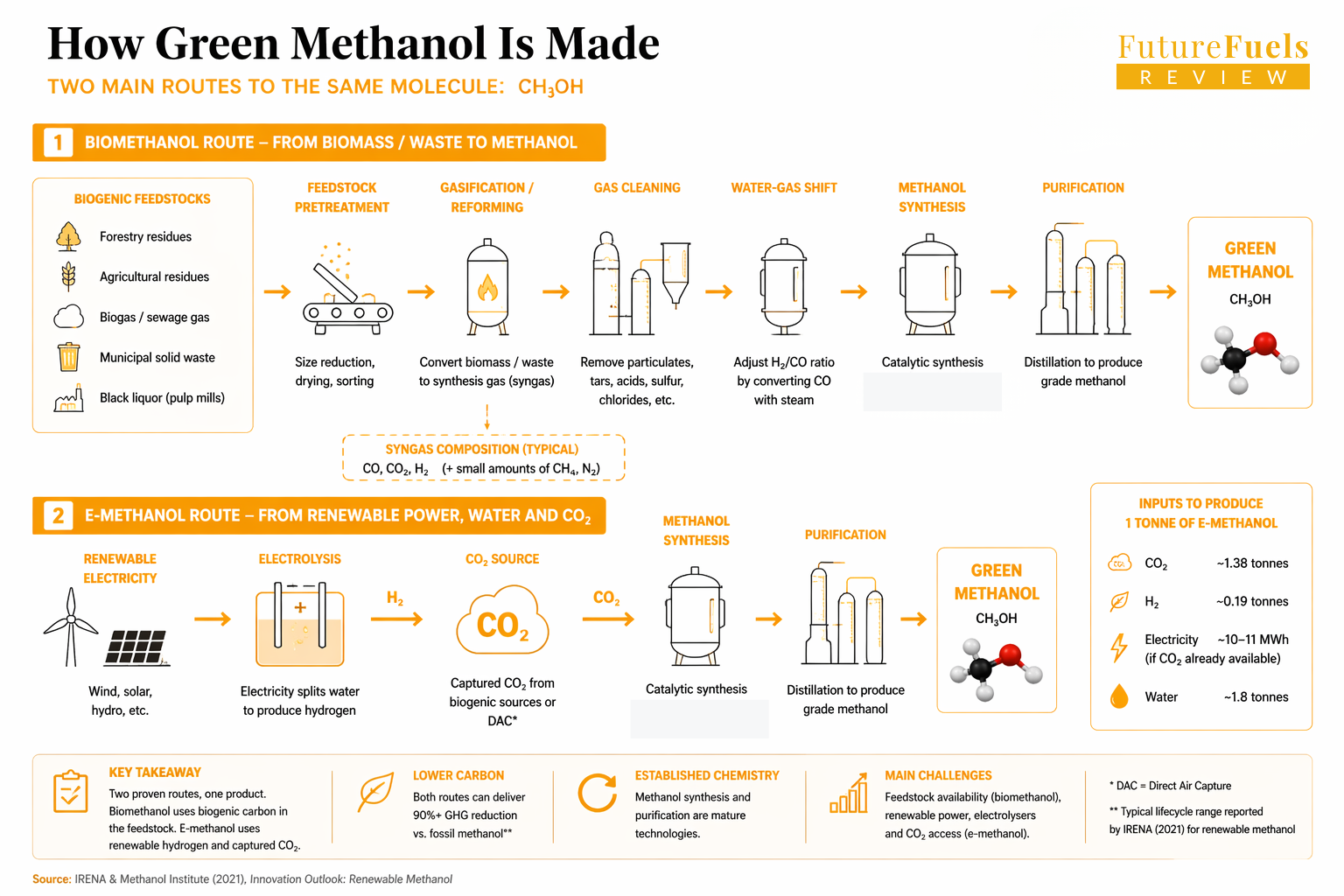
That is why current supply remains limited. The technology is real, but feedstock systems are constrained. On the biomethanol side, the cheapest feedstocks are residues, wastes and industrial by-product streams, but such low-cost feedstocks are hard to aggregate and process at scale. On the e-methanol side, supply depends on cheap renewable power and access to renewable or biogenic CO2, both of which remain scarce relative to the scale of the conventional methanol market.
Operating plants show both the progress and the gap. In Sweden, Södra’s Mönsterås mill produces about 5,250 tonnes per year of biomethanol from the pulping process. In Iceland, Carbon Recycling International’s George Olah plant has long been an early commercial proof point at about 4,000 tonnes per year, using CO2 and renewable hydrogen. In Denmark, European Energy’s Kassø facility started production in 2025 and is designed to produce 42,000 tonnes of e-methanol annually, which is a major milestone because it is the first large-scale commercial e-methanol plant. Even so, 42,000 tonnes is still tiny against a roughly 100 million tonne global methanol market.
China also deserves a place in this story, although the terminology needs to be precise. The country already has operating commercial CO2-to-methanol plants. The best documented is the Anyang plant in Henan, which Carbon Recycling International says started production in 2022 and can produce about 110,000 tonnes per year by reacting captured waste CO2 with recovered hydrogen. Another is the Jiangsu Sailboat plant in Lianyungang, which was commissioned in 2023 and can produce 100,000 tonnes per year from recycled CO2 and by-product hydrogen streams.
Meanwhile, some of China’s largest dedicated green methanol projects are still moving toward operation rather than already producing at scale. Goldwind’s Xing’an League project in Inner Mongolia broke ground in 2024 and is designed for 500,000 tonnes per year, combining renewable power with biomass-based carbon inputs. Goldwind has said first production is expected from 2026. That makes it one of the most important near-term projects globally, but not yet an operating plant in the same sense as Kassø, Anyang or Jiangsu Sailboat.
Green methanol is not one technology. It is a family of production routes built around different feedstock systems. In biomethanol, the carbon is embedded in biomass or biogenic process streams from the outset. In e-methanol, the carbon is supplied separately as captured CO2, while the hydrogen comes from renewable electricity and water. The chemistry in the methanol reactor is well established. The real constraints are upstream: sustainable biomass supply, low-cost renewable power, electrolyser capacity, and access to sustainable CO2. That is what will determine how fast green methanol can scale.


